
Direct Mail Response Depends on the Ask, Not the Format
Ask about direct mail response rates and you will get numbers between 0.2% and 5%, which is useless. The variance is not noise. It is driven by one variable that almost nobody controls for.
The ask determines the rate
Not the paper stock, not the format, not the design. What you ask the recipient to do.
| What you ask for | Response rate | Pieces per response | |---|---|---| | Purchase or order | 0.2% | 500 | | Free demo or form fill | ~2% | 50 | | Committal account signup | ~0.25% | 400 |
Ten times the response for a lighter ask. That single fact determines whether a campaign works.
The third row is worth pausing on, because it looks like it contradicts the pattern. A financial services account signup is nominally free — no money changes hands. But it requires identity verification, bank details, and a decision to move a business relationship. It performs eight times worse than a demo request despite both being free.
So the gradient is not free-versus-paid. It is how much the recipient has to commit — time, information, disruption, risk.
Pricing a campaign in advance
At roughly $1 per piece all-in — print, postage, list, creative — the arithmetic is direct:
- Purchase ask: 500 pieces per response = $500 per customer
- Demo ask: 50 pieces per response = $50 per lead, then apply your lead-to-customer rate
If your demos close at 20%, that $50 lead becomes a $250 customer. Against a $300 bar, that works. The purchase ask at $500 does not.
Same list, same spend, same creative. The ask decides it.
Note that the $1 figure is all-in. Quoted per-piece printing costs exclude postage, list rental, and design, and campaigns get scoped on the printing quote more often than you would expect.
The design consequence
If direct mail does not clear your bar with a purchase ask — and for most businesses it will not — the answer is usually to change the ask rather than abandon the channel. Ask for something lighter, then convert in a second step where the cost per attempt is far lower.
This applies well beyond mail. Every channel has an ask attached, and the ask is a variable you control. When a channel fails the arithmetic, check whether you are asking for too much at first contact before concluding the channel does not work.
Direct mail response rates vary by a factor of ten depending on what you ask for — and format has little to do with it.
Related Blogs
Your Google Ads Account Has Two Businesses In It
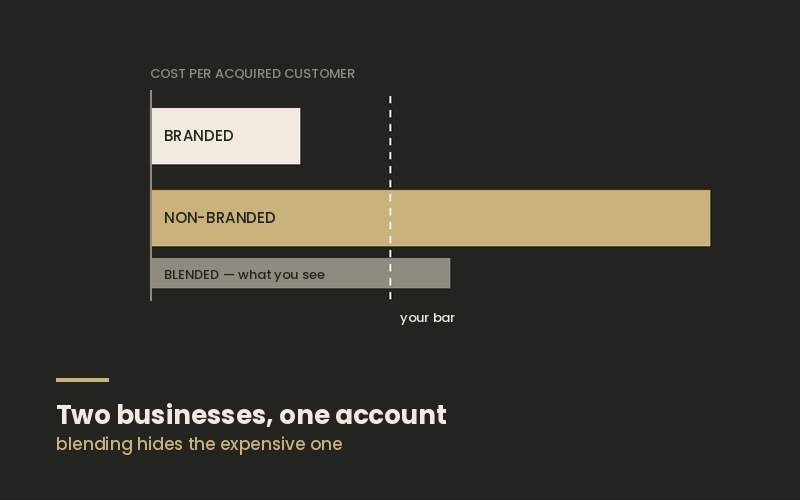
Branded and non-branded search are different businesses with different economics, and blending them hides the expensive one.
Why Most Website A/B Tests Can Never Work
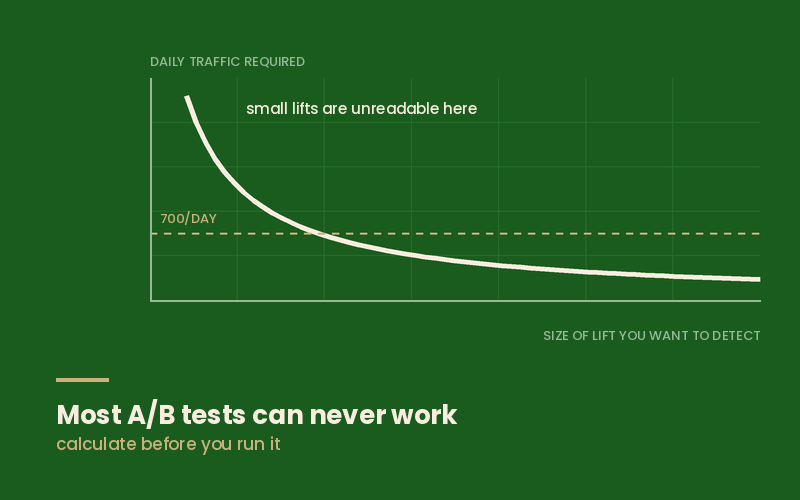
You can calculate before you start whether a test has enough traffic to produce an answer. Most don't, and they end in "we're not sure."
The Conversion Levers Marketing Doesn't Own
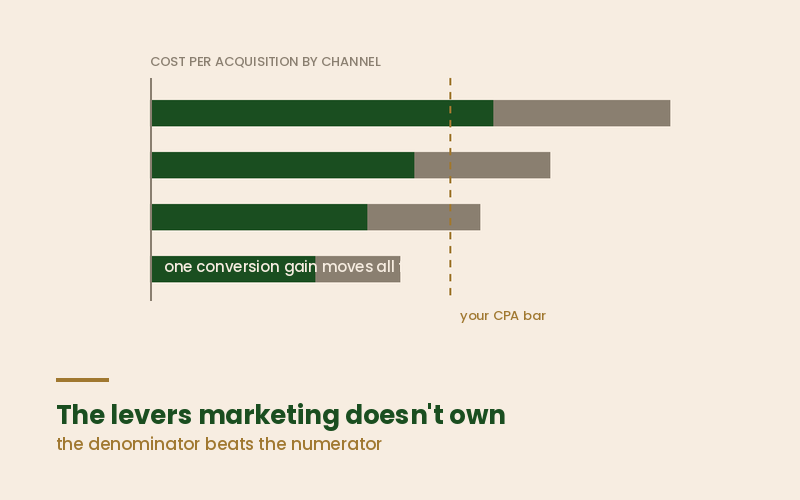
The variables with the largest effect on conversion are usually owned by finance or operations, and no one has priced the marketing consequence.
Get in touch
with us
Contact Us