
Your Google Ads Account Has Two Businesses In It
Open any mature paid search account and you will find two fundamentally different activities sharing a budget, a report, and a blended cost per acquisition that describes neither.
They are not the same channel
Branded search — people typing your company name — is demand capture. Those customers had already decided; they used search as navigation. The clicks are cheap because nobody else bids seriously on your name, and they convert well because intent is already formed.
Non-branded search — category and problem terms — is demand creation, or closer to it. The buyer does not know you. The clicks cost several times more and convert at a fraction of the rate.
Blend them and the cheap branded volume subsidizes everything else. The account looks acceptable. Individual campaigns inside it can be running at three or four times your bar without anyone seeing it.
Nobody is concealing anything. The structure of the default reporting simply makes it invisible.
The scaling consequence
Here is the part that breaks growth plans: branded search does not scale.
The demand is fixed. Only so many people search your name in a given month, and bidding more aggressively does not create more of them. You can spend more on branded terms and get almost nothing additional for it.
So branded search belongs in your current-state accounting — count it fully, in both spend and customers — but it does not belong in a growth plan. When you are deciding where incremental budget goes, branded search should not be in the candidate set unless you have specific evidence of unmet branded demand.
Plans that assume paid search will scale in proportion to budget are usually plans built on a blended number where branded volume is doing the work.
What to do
Separate them in reporting. Not just campaign naming — separate cost per acquired customer for each. Do this before making any judgment about the account.
Set the bar from your economics. Six months of gross margin per customer gives you a ceiling. Then judge non-branded campaigns against it individually.
Cut what exceeds it. In one engagement this meant removing about $300,000 a year of spend where campaigns were acquiring customers at close to $1,000 against a $300 bar. The cost was roughly 300 customers a year. Around $200,000 was freed for testing channels that had never been tried.
That last part matters. The money did not go to the bottom line — it went into the test queue. Cutting waste in a proven channel is one of the two ways a testing program gets funded, and it is the faster of the two.
The check
Split branded from non-branded and compute cost per acquired customer for each. It takes an hour, and it is the highest-return hour available in most paid search accounts.
Branded and non-branded search are different businesses with different economics, and blending them hides the expensive one.
Related Blogs
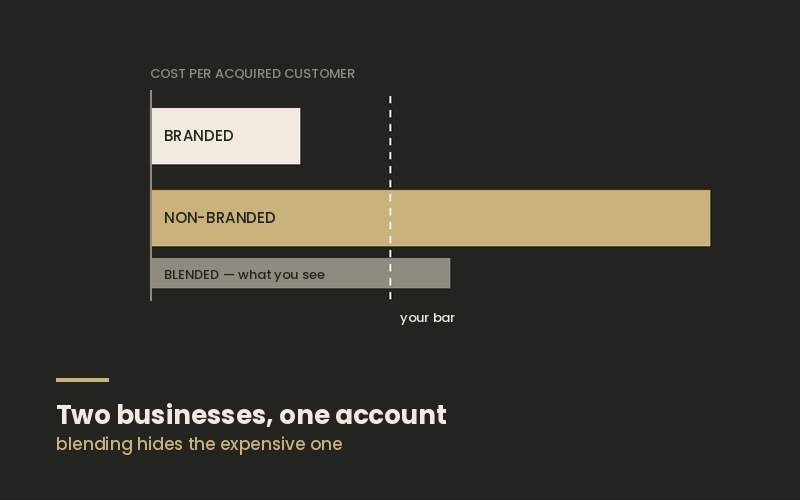
Your Google Ads Account Has Two Businesses In It
Branded and non-branded search are different businesses with different economics, and blending them hides the expensive one.
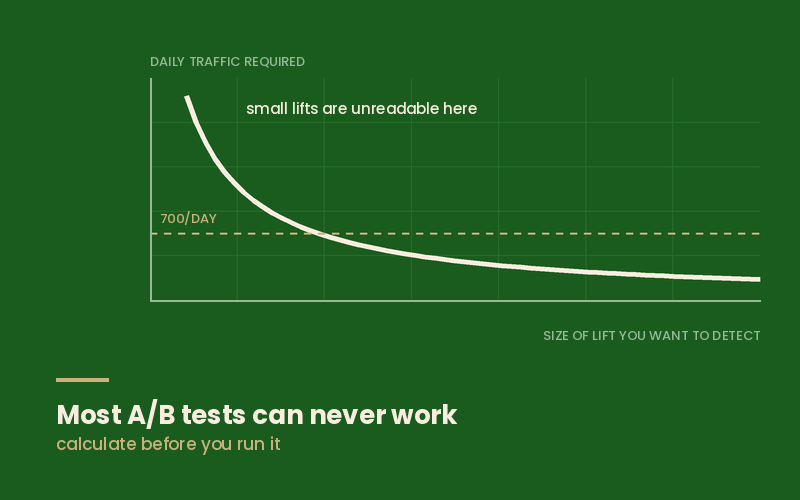
Why Most Website A/B Tests Can Never Work
You can calculate before you start whether a test has enough traffic to produce an answer. Most don't, and they end in "we're not sure."
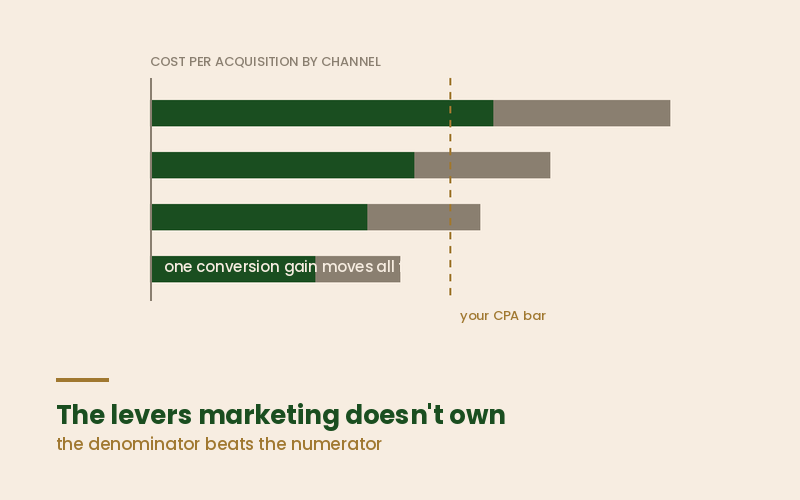
The Conversion Levers Marketing Doesn't Own
The variables with the largest effect on conversion are usually owned by finance or operations, and no one has priced the marketing consequence.
Get in touch
with us
Contact Us