
Cost per acquisition is cost per visitor divided by conversion rate. Almost all marketing effort goes into the numerator — cheaper clicks, better targeting, new channels.
The denominator is worth more, and here is why: a numerator gain applies to one channel. A denominator gain applies to every channel at once, including channels you have not tested yet and channels you previously pruned because they did not clear the bar. It is usually a fixed cost rather than a per-visitor one, so its marginal cost collapses as volume grows. And it compounds with every future test you run.
Which is a strong argument for ranking conversion work ahead of channel tests of comparable expected value.
The two-owner problem
At the moment of purchase, a customer faces an offer and an obstacle. Both are usually set by someone outside marketing.
Choice-set breadth. How many options the customer picks from is a conversion input. But it is typically managed as an inventory question, sized by carrying cost and operational complexity — optimized against the wrong objective entirely. Nobody has calculated what a narrower or broader set does to conversion, because in the org chart it is not a marketing variable.
Checkout friction. Required fields, account creation, verification steps, payment options, delivery thresholds. Each is owned by finance, legal, operations, or engineering, each for a defensible reason, and the cumulative conversion cost has never been computed.
Price and terms. Owned by finance. Marketing is told the price and works within it. Whether a different price produces more revenue per visitor is testable and rarely tested.
The tell is a two-owner gap: someone outside marketing sets the variable, marketing has never priced it, and nobody has measured the conversion consequence. That gap is exactly where these levers hide, and it is why channel analysis never surfaces them.
How to find them
Walk your own purchase path as a stranger, on a phone, and count every point where you are asked for something. For each, ask who decided it was required and whether anyone has measured what it costs.
Then look at the offer itself. If customers choose from a set, ask who sized the set and against what objective.
Both questions take an afternoon. Neither is usually anybody's job.
Why the returns are so good
A channel test tells you about one channel. A conversion improvement re-prices your entire channel portfolio — including the ones you already rejected.
If your conversion rate rises from 1% to 1.5%, every cost-per-acquisition figure you have falls by a third. Channels that failed the arithmetic now clear it. Which means the correct response to a conversion gain is not just enjoying cheaper customers — it is going back and re-running the channels you dismissed, because the ranking was a function of the conversion rate at the moment you computed it.
The variables with the largest effect on conversion are usually owned by finance or operations, and no one has priced the marketing consequence.
Related Blogs
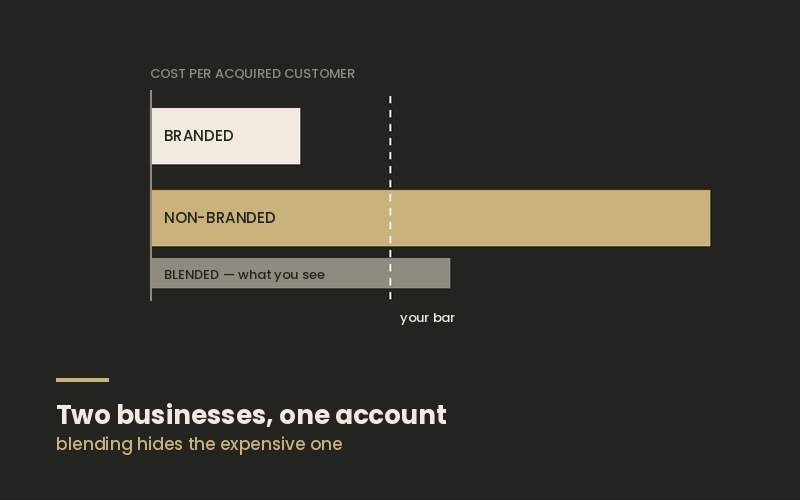
Your Google Ads Account Has Two Businesses In It
Branded and non-branded search are different businesses with different economics, and blending them hides the expensive one.
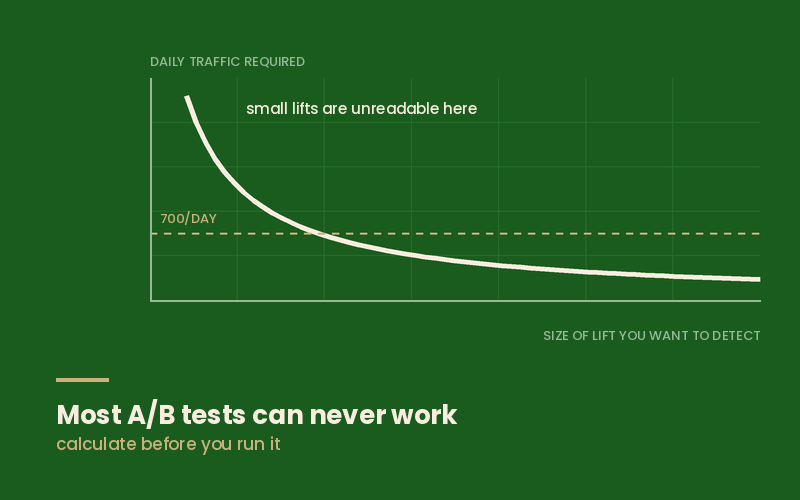
Why Most Website A/B Tests Can Never Work
You can calculate before you start whether a test has enough traffic to produce an answer. Most don't, and they end in "we're not sure."
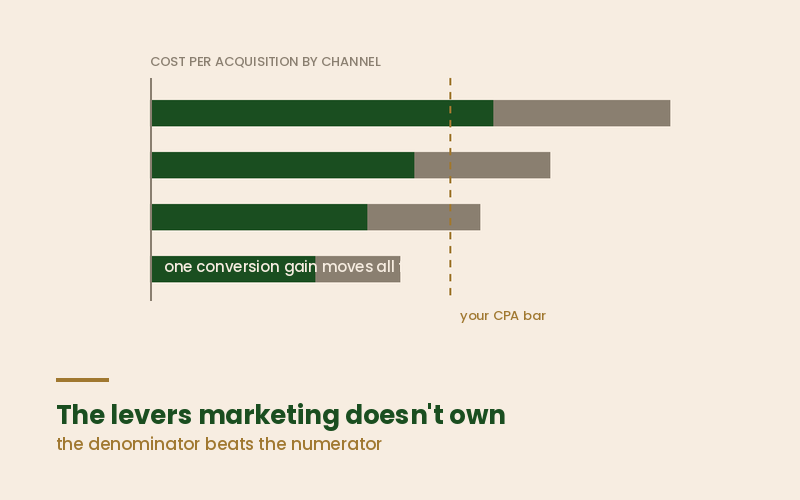
The Conversion Levers Marketing Doesn't Own
The variables with the largest effect on conversion are usually owned by finance or operations, and no one has priced the marketing consequence.
Get in touch
with us
Contact Us