
Hitting Your CPA Target Isn't Enough
Two channels. Both acquire customers at around $200, comfortably inside the bar. On efficiency they are indistinguishable, and most analysis would stop there.
One of them could absorb about $60,000 a year before running out of audience. The other absorbed $12 million a year for as long as we cared to spend.
Same cost. A hundredfold difference in what it could do for the business. And the choice between them had nothing to do with efficiency.
Efficiency and capacity are different questions
Cost per acquisition tells you whether a channel is worth using. It says nothing about how much of your problem it can solve.
A channel has a scale ceiling — the point past which more spend stops producing proportionally more customers, because you have exhausted the audience that responds. Beyond it, additional budget buys attention from people progressively less likely to buy, and your cost per acquisition climbs until the channel stops clearing the bar entirely.
The ceiling has nothing to do with the CPA below it. A narrow, well-matched audience can produce excellent economics and be very small.
Why this gets missed
Because it is invisible until you hit it, and by then you have built a plan around it.
The usual sequence: you test a channel, the economics look good, you scale it, growth is strong for two quarters, then results flatten. The instinct is to blame creative fatigue, or the agency, or the season. Sometimes that is right. Often the channel simply ran out of people.
The failure is not the ceiling itself. It is having built a growth plan on the assumption that a channel performing well at $50,000 would perform the same at $500,000, without asking whether the audience was that large.
How to find the ceiling before it finds you
Estimate the addressable audience. How many people plausibly buy this, and what fraction does this channel reach? A channel serving a 50,000-person audience cannot deliver 20,000 customers a year regardless of how well it converts.
Watch cost per acquisition as spend increases. Rising CPA at increasing budget is the ceiling arriving. Track it as a curve, not as a monthly average — the average lags the reality.
Watch cohort quality, not just cost. Sometimes CPA holds steady while the customers get worse — shorter retention, lower value. That is the same phenomenon showing up on the other side of the equation.
Run a deliberate step change. If spend has been flat, saturation is untestable from your history. Double the budget in a controlled way for a defined period and read what happens. A test that costs a month of overspend is cheap compared to building a three-year plan on a channel that tops out in month eight.
The planning consequence
When you set a growth target, reconcile it against channel capacity before committing to it. Add up what each channel can realistically absorb. If the sum falls short of the target, the plan is not aggressive — it is arithmetically impossible, and the gap has to be filled by channels that do not yet exist.
Which means the test queue is not a side project. It is what makes the number reachable.
A channel can hit your cost target perfectly and still be incapable of solving your growth problem.
Related Blogs
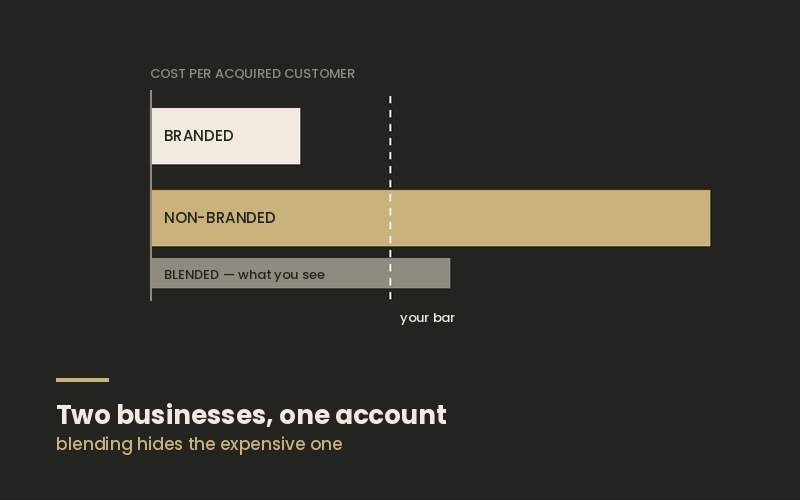
Your Google Ads Account Has Two Businesses In It
Branded and non-branded search are different businesses with different economics, and blending them hides the expensive one.
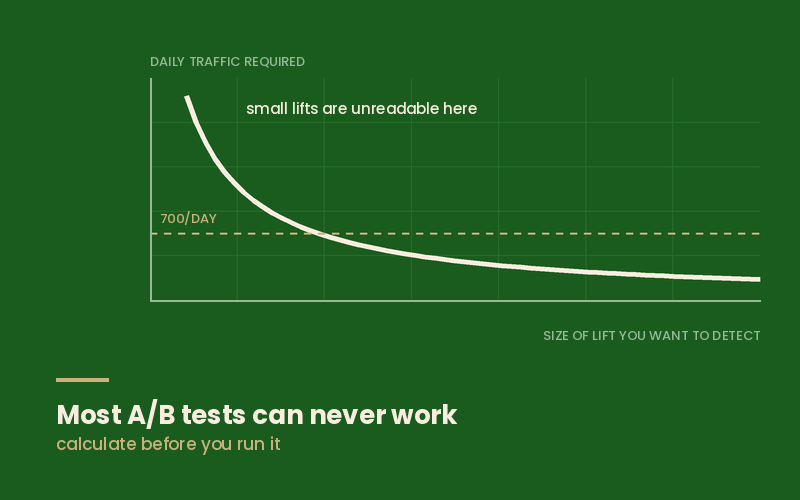
Why Most Website A/B Tests Can Never Work
You can calculate before you start whether a test has enough traffic to produce an answer. Most don't, and they end in "we're not sure."
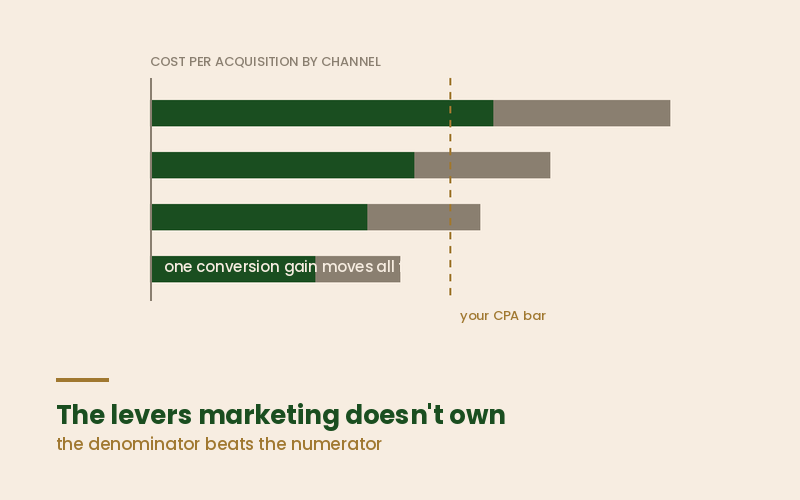
The Conversion Levers Marketing Doesn't Own
The variables with the largest effect on conversion are usually owned by finance or operations, and no one has priced the marketing consequence.
Get in touch
with us
Contact Us