
How to Kill a Marketing Channel Before You Spend a Dollar on It
Most channel decisions get made by running a test and seeing what happens. That is reasonable when you have no other option. But for paid search specifically, you can often reach the answer before spending anything, and the arithmetic takes about ten minutes.
Start with what you can afford to pay
You need one number: your maximum cost per acquired customer. If you have not derived it, six months of gross margin per customer is a reasonable place to start. A customer producing $50 a month in gross margin gives you $300.
That is your CPA ceiling.
Convert it into a bid ceiling
Cost per acquisition is cost per visitor divided by conversion rate. Turn that around and you get the most you can pay for a click:
Max CPC = CPA ceiling × conversion rate
At a $300 ceiling and 2% conversion, you can pay $6 a click. At 1%, $3.
A rough table:
| CPA ceiling | Max CPC at 2% | Max CPC at 1% | |---|---|---| | $200 | $3.78 | $1.89 | | $500 | $9.45 | $4.73 | | $1,000 | $18.90 | $9.45 |
One refinement worth making: not every click becomes a visitor. Measured across accounts, about 94.5% of clicks arrive as sessions — people who leave before the page loads, mostly on slow or mobile-heavy sites. So divide your ceiling by roughly 1.06 to get the honest figure. Small, but it moves the answer at the margin.
Then go look up what the clicks actually cost
Open Google's Keyword Planner and enter the terms you would want to buy. It returns cost-per-click estimates for each.
Compare them to your ceiling.
If the terms you need are priced above what you can pay, the channel cannot work at any conversion rate in a plausible range — and you have established that without spending anything. Not "it might be expensive." It cannot clear the bar.
What to do when the answer is no
Look at longer-tail terms. Head terms are expensive because everyone bids on them. More specific phrases often cost a fraction and convert better, because the intent is sharper. The volume is smaller, which may or may not matter depending on what you need.
Check whether your conversion rate is the real constraint. If you need a $3 CPC and the terms cost $6, doubling conversion solves it — and conversion work applies to every channel at once, not just this one. That may be a better use of the next month than finding another channel.
Look at channels priced differently. Search is an auction on intent, which is why it is expensive where intent is valuable. Channels priced on impressions have different economics entirely, and a business locked out of search on cost is not necessarily locked out of everything.
Why this matters more than it seems
The usual alternative is a $10,000 test over three months that produces an ambiguous answer, because it was never large enough to produce a clear one. Ten minutes with a calculator and a keyword tool often gets you a definitive answer instead.
It also works in the other direction. When the terms come in comfortably under your ceiling, you have a channel worth testing and a specific bid to test at — rather than a guess and a hope.
If the terms you need cost more than your economics allow, no conversion rate saves you — and you can find that out in ten minutes.
Related Blogs
Your Google Ads Account Has Two Businesses In It
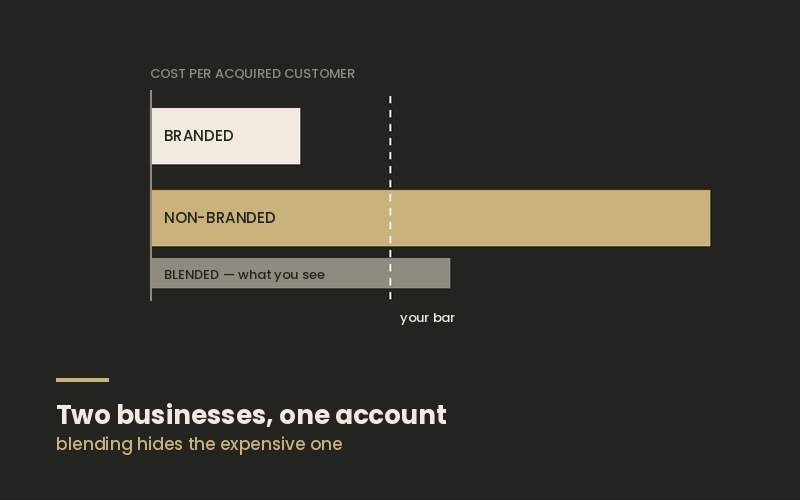
Branded and non-branded search are different businesses with different economics, and blending them hides the expensive one.
Why Most Website A/B Tests Can Never Work
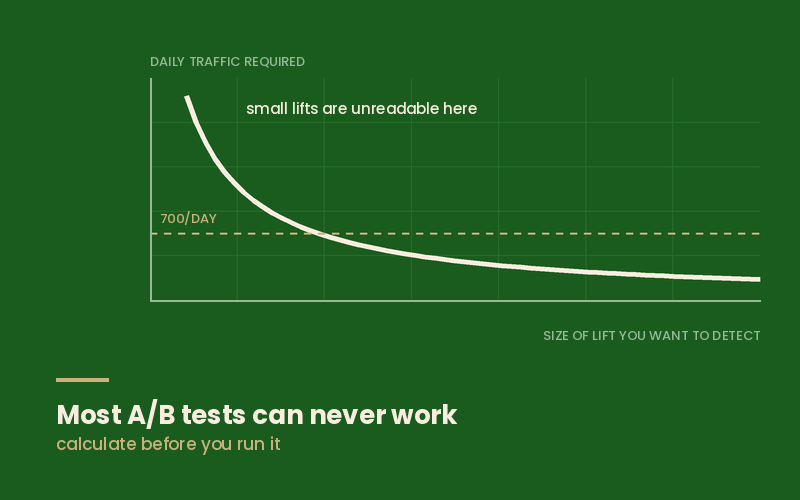
You can calculate before you start whether a test has enough traffic to produce an answer. Most don't, and they end in "we're not sure."
The Conversion Levers Marketing Doesn't Own
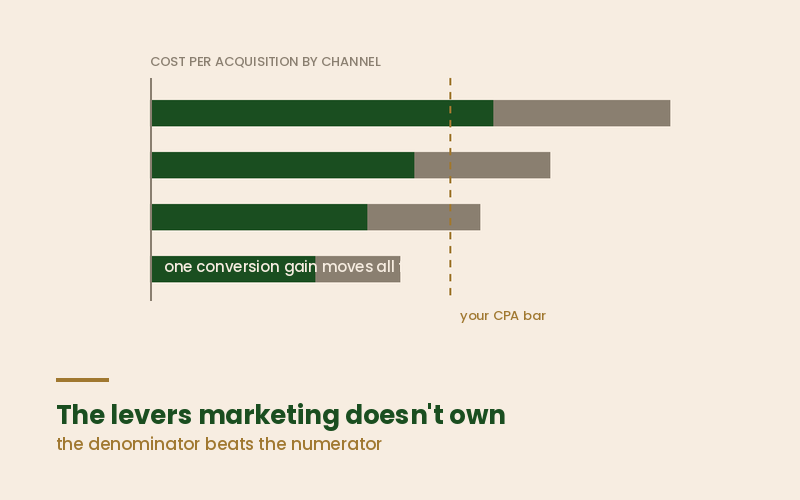
The variables with the largest effect on conversion are usually owned by finance or operations, and no one has priced the marketing consequence.
Get in touch
with us
Contact Us