
Six-Month Payback: The Rule That Keeps Companies Solvent
There is a common piece of advice that says you can afford to spend up to a third of lifetime value acquiring a customer. Or half. The specific fraction varies, and it is not the problem. The problem is the metric.
Lifetime value is a claim about the future — a lot of it, in a business with long retention. A customer worth $3,000 over four years is genuinely worth $3,000. But you cannot pay this month's invoices with year three.
The constraint is cash, not profitability
Consider two businesses. Both have customers worth $3,000 in gross margin. Both spend $900 to acquire one. Both have a healthy 3.3 ratio.
The first collects $250 a month. It recovers the $900 in under four months and then funds the next customer out of the last one's revenue. Growth is close to self-financing.
The second collects $75 a month across a longer, stickier relationship. Same lifetime value, same ratio. But it takes twelve months to recover each acquisition. Every customer it adds is a twelve-month cash hole, and growing faster digs the hole faster.
The second business can be perfectly profitable on paper and still run out of money. This is the most common way a growing company fails: not because the unit economics are wrong, but because the timing is, and the ratio nobody was watching didn't show it.
Six months, on gross margin
The rule worth holding: you should recover acquisition cost within six months, measured on gross margin.
Two parts, both load-bearing.
Six months because that is what a privately held company without outside capital can generally absorb. It is not a law of nature and it is not about forecasting — it is about who is funding the gap. A venture-backed company that raised specifically to buy growth can run payback out for years, because an investor has already agreed to carry it. A private company funding growth from its own operations is carrying the gap itself, and six months is roughly where that stops being comfortable.
So the number is set by your capital structure, not by your marketing. Before adopting the rule, ask who absorbs the shortfall between spending and recovering. If the answer is "we do, out of cash flow," six months is the right horizon. If the answer is "our investors, deliberately," pick a longer one on purpose and know why.
On gross margin for the same reason lifetime value runs on margin. Revenue that goes straight back out as cost of delivery cannot repay anything.
Working it backward is where it earns its keep
The rule is most useful run in reverse. Rather than checking a CPA after the fact, derive the ceiling before you spend.
If a customer produces $50 a month in gross margin, six months gives you $300. That is your maximum acquisition cost — not a target, a ceiling. Every channel now gets evaluated against a specific number you can check before committing budget. Paid search terms priced above what $300 supports at your conversion rate are eliminated without a test.
This is exactly how one engagement identified about $300,000 a year of paid search spend that had to go: the campaigns in question were acquiring customers at close to $1,000 against a $300 bar. Removing them cost roughly 300 customers a year and freed about $200,000 for testing channels that had never been tried.
When to break the rule
Deliberately, and with a reason you would say out loud.
If you have raised capital specifically to buy growth ahead of profitability, a longer payback is the strategy rather than a mistake — someone has agreed to fund the gap and that is what the money is for. If you are defending a position and letting a competitor take customers is the more expensive option, that is a real argument too.
What is not a real argument is "our LTV supports it." It does — over four years. The question is who is paying for months one through eight, and whether they know they signed up for it.
Lifetime value tells you the ceiling. Payback period tells you the speed. Confusing them is how profitable companies run out of cash.
Related Blogs
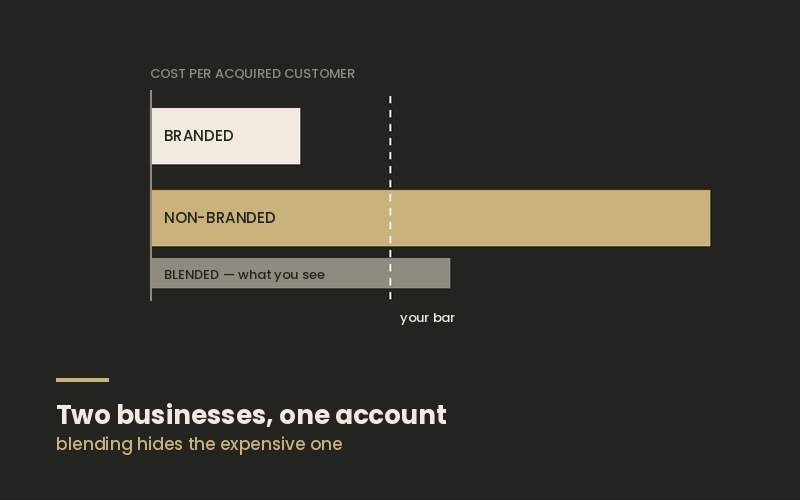
Your Google Ads Account Has Two Businesses In It
Branded and non-branded search are different businesses with different economics, and blending them hides the expensive one.
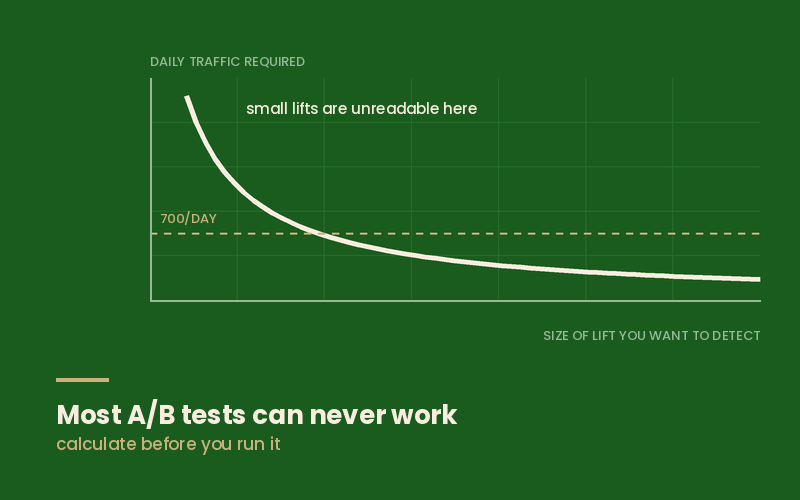
Why Most Website A/B Tests Can Never Work
You can calculate before you start whether a test has enough traffic to produce an answer. Most don't, and they end in "we're not sure."
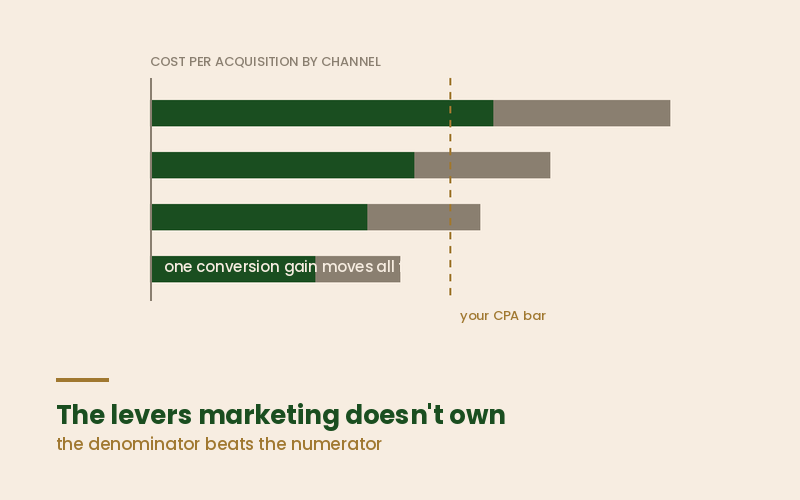
The Conversion Levers Marketing Doesn't Own
The variables with the largest effect on conversion are usually owned by finance or operations, and no one has priced the marketing consequence.
Get in touch
with us
Contact Us