
The Cheapest Way Into a New Channel Is the One Nobody Owns
Launching a channel usually means buying your way in: media budget, cold traffic, and a wait to find out whether the economics work. There is a cheaper route that most companies walk past, and it costs nothing in media.
Use one channel's customers to start the next one
Every channel you already run puts you in front of customers repeatedly — shipments, packaging, receipts, onboarding emails, invoices, support replies. Those touchpoints are owned. You are not renting attention; you already have it.
They can be used to launch the next channel.
A consumer brand running a crowdfunding campaign put a marketplace coupon into every shipment. Those customers redeemed it, and the resulting orders and reviews gave the marketplace listing the early velocity its ranking algorithm requires. The channel went from zero to over $100,000 a month within three months, with no acquisition spend against it. The website launched in parallel and reached $1,500–2,000 a day.
The media cost of that marketplace launch was zero. The customers were already ours; we simply pointed them somewhere new.
Why it works
Most channels have a cold-start problem that has nothing to do with your product. Marketplaces rank on sales velocity and reviews, so a new listing is invisible until it has sales — and it cannot get sales while invisible. Retail buyers want sell-through data you cannot produce without shelf space. Referral programs need enough participants to generate momentum.
Seeded customers solve exactly that. They are not the channel's growth engine; they are the ignition.
Why it gets missed
It falls between two owners. Your marketplace manager does not control shipping inserts. Your fulfillment lead does not think about marketplace ranking. Your email manager owns the onboarding sequence but not the referral program launching next quarter.
Nobody's job description contains this move, so nobody makes it. It is not a hard idea — it is an organizational blind spot, and it survives in companies that are otherwise well run.
The diagnostic
Ask it about every channel pair you have:
What touchpoint that channel A already owns could seed channel B?
Work through them. Shipments, packaging, order confirmations, onboarding sequences, invoices, receipts, support conversations, the thank-you page. Each is a place where an existing customer is already paying attention.
Then ask what you would have paid to acquire that first cohort cold. The gap is what seeding is worth.
The limit
This launches a channel; it does not scale one. The seeded cohort is finite — you only have so many existing customers — and once it is exhausted the channel has to stand on its own economics.
But it changes the shape of the bet. Rather than spending to find out whether a channel works, you get it to a readable state for close to nothing, and only commit real budget once there is evidence. In a business where the testing budget is the binding constraint, that is worth more than the media savings.
The cheapest way into a new channel is usually an asset you already own — and it is systematically missed because nobody owns it.
Related Blogs
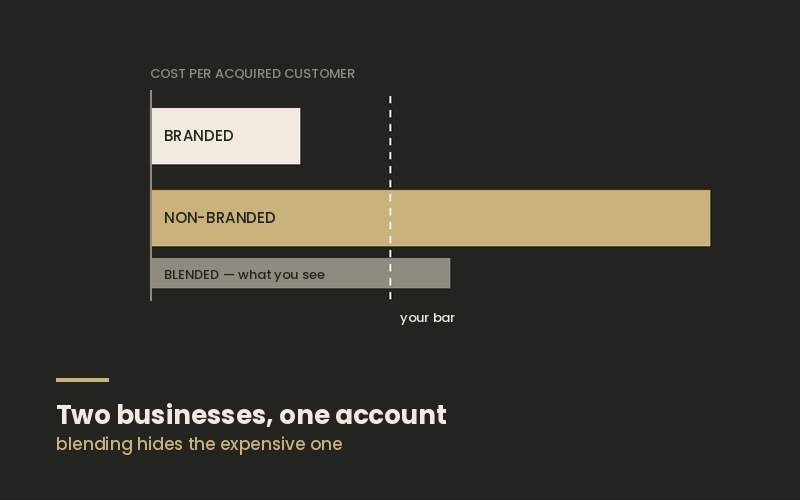
Your Google Ads Account Has Two Businesses In It
Branded and non-branded search are different businesses with different economics, and blending them hides the expensive one.
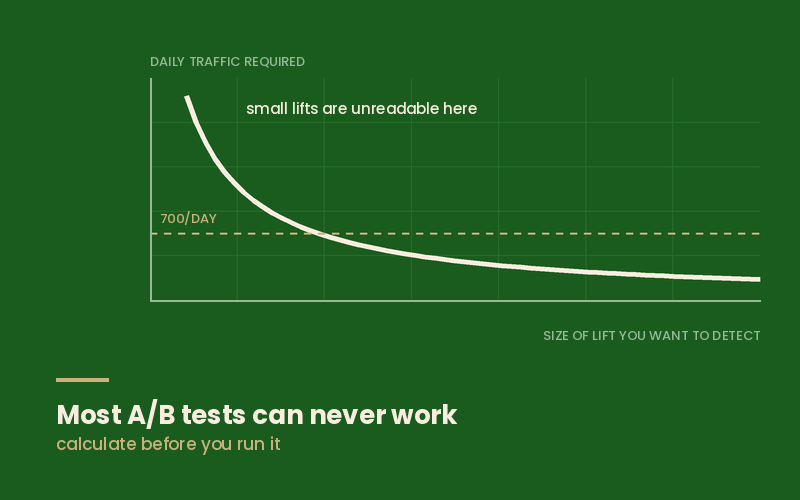
Why Most Website A/B Tests Can Never Work
You can calculate before you start whether a test has enough traffic to produce an answer. Most don't, and they end in "we're not sure."
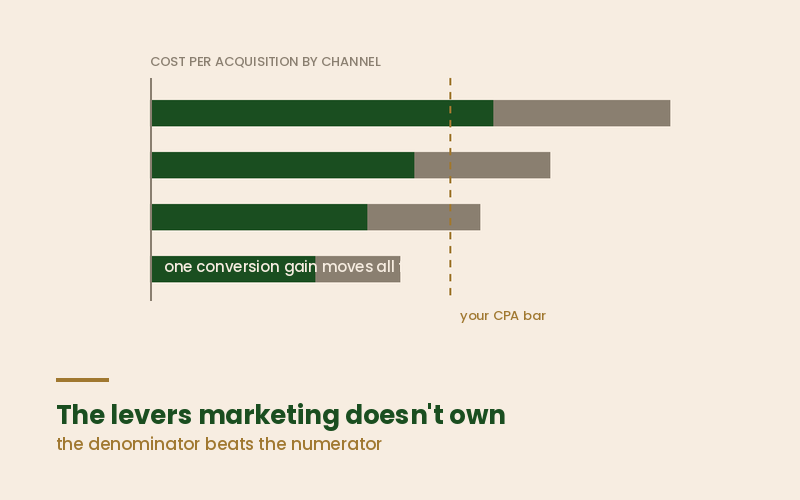
The Conversion Levers Marketing Doesn't Own
The variables with the largest effect on conversion are usually owned by finance or operations, and no one has priced the marketing consequence.
Get in touch
with us
Contact Us