
The Only Marketing Ratio That Matters, and What Yours Is Telling You
If you have a lifetime value and a cost per acquisition, dividing one by the other produces the single most useful number in marketing. It also produces the most commonly misread one, because the failure modes at both ends look nothing alike.
Under 3: you have an optimization problem, and spending more will make it worse
If a customer is worth $900 in gross margin and costs $400 to acquire, your ratio is 2.25. That sounds like it works — you make more than you spend. But that $500 difference has to cover everything else the company does: product, engineering, overhead, and the cost of capital tied up while you wait to be repaid.
The instinct at this ratio is usually to spend more, because each customer is nominally profitable. It is the wrong instinct. Acquisition costs rise as you scale — you exhaust the cheapest audience first — so more spend means a worse ratio, not a proportionally bigger business. At 2.25 you are not looking at a growth problem. You are looking at an efficiency problem, and the work is in the ratio itself: better conversion, better retention, cheaper channels, or a higher price.
Scaling a broken ratio does not fix it. It makes the same mistake more times per month.
Between 3 and 5: healthy, and the place to be scaling
This is the band where the acquisition machine is working. Each customer covers their acquisition cost with enough left over to fund the business. Here the answer to "should we spend more" is usually yes, provided you can find the volume — and provided payback timing works, which is a separate constraint worth its own article.
Above 5: you are probably underinvesting
This is the one that surprises people, because a high ratio feels like success.
A ratio of 8 means you are acquiring customers at a small fraction of their worth. That sounds excellent, and the usual reaction is to leave things alone. But consider what it implies: you are almost certainly leaving customers on the table who would have been profitable to acquire at twice what you are currently paying. You are optimizing efficiency in a situation that calls for volume.
Businesses sit here for two reasons. Either they are capacity-constrained and cannot serve more customers — a real reason, and one worth naming honestly. Or they are cautious, and caution has quietly cost them years of compounding growth. In a competitive category the second one is expensive, because the customers you decline to bid for are acquired by somebody else, permanently.
If your ratio is above 5 and you are not capacity-constrained, the question is not whether to spend more. It is why you haven't.
The constraint the ratio cannot see
One important limit. A healthy ratio tells you a customer is worth acquiring. It does not tell you that you can afford to acquire them right now.
You can sit at a ratio of 7 and still be unable to spend another dollar, because the return arrives over the following two years and the invoice arrives this month. Every additional customer is cash out today against cash in later, and a business without reserves runs into that wall long before it runs out of profitable customers to buy.
This is why a good ratio and a cash crunch coexist so often, and why founders in that position feel like the numbers are lying to them. They are not. The ratio is answering a question about worth; the constraint is one of timing. That is a different measurement, and it is the subject of next month's article.
Compute it by channel, not blended
One warning that matters more than the thresholds. A blended ratio averages your best channel with your worst, and the average tells you very little about either. A business at a comfortable 4.2 overall can easily contain one channel at 9 that should be scaled hard and another at 1.5 that should be shut off this week — and the blended number hides both.
Compute the ratio per channel. Act on those. The blended figure is for board decks.
LTV:CAC under 3 means you have an optimization problem. Over 5 usually means you are underinvesting — which surprises people.
Related Blogs
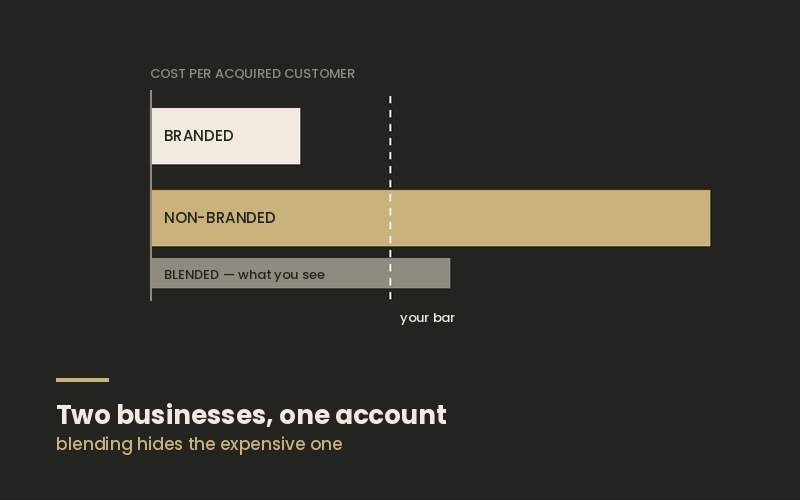
Your Google Ads Account Has Two Businesses In It
Branded and non-branded search are different businesses with different economics, and blending them hides the expensive one.
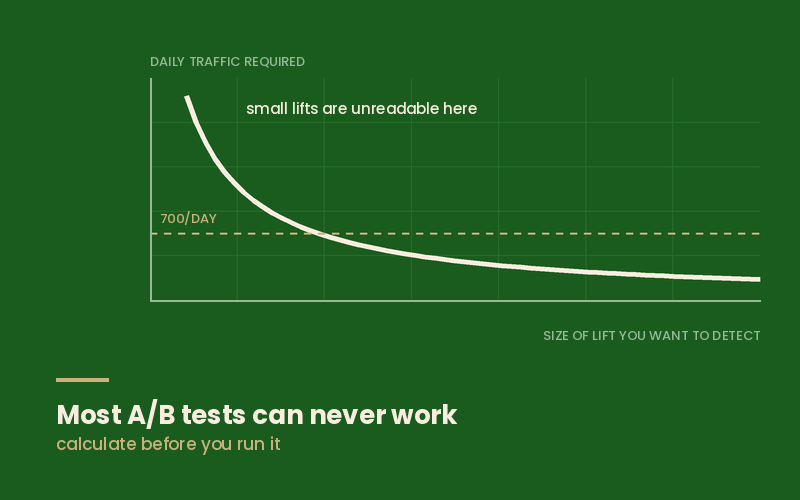
Why Most Website A/B Tests Can Never Work
You can calculate before you start whether a test has enough traffic to produce an answer. Most don't, and they end in "we're not sure."
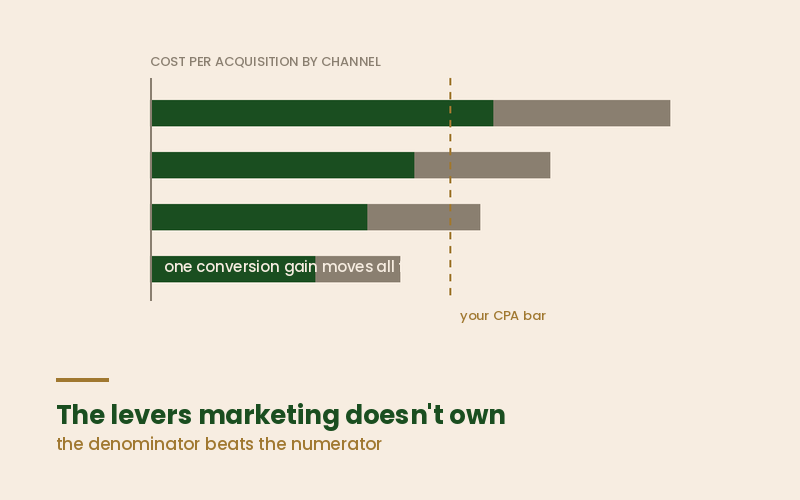
The Conversion Levers Marketing Doesn't Own
The variables with the largest effect on conversion are usually owned by finance or operations, and no one has priced the marketing consequence.
Get in touch
with us
Contact Us