
You Probably Don't Know What a Customer Is Worth
Here is a question worth asking your finance team this week: what is a customer worth to us?
In most companies, one of three things happens. You get a blank look. You get a number nobody can explain the derivation of. Or you get a number that turns out to be built on revenue rather than margin, which means it is wrong by whatever your cost of goods happens to be.
This matters more than it sounds. Almost every marketing decision you make is secretly a comparison against this number. Is a $300 cost per acquisition good? There is no answer to that question in the abstract. It works comfortably if a customer is worth $2,000 to you, and it loses money on every sale if they are worth $400. Without the number, every spending decision is a matter of opinion, and the loudest opinion in the room wins.
Start with churn, not with a survey
Customer lifetime value has a reputation for being complicated. It is not, and the complicated versions are usually less useful than the simple one.
The simple version: your average monthly churn rate determines how long an average customer stays. If 4% of your customers cancel each month, the average customer lasts about 25 months — one divided by 0.04. Multiply that lifetime by what a customer pays you each month, and you have lifetime revenue.
That is the whole calculation. You need two numbers, both of which are sitting in your billing system right now: how much a customer pays per month, and what fraction of customers leave each month.
For e-commerce, the equivalent runs on repeat purchase behavior rather than subscription churn — how many times an average customer buys over twelve months, and at what order value. Same logic, different inputs.
Then convert to margin, because that is what you can actually spend
This is where most calculations go wrong, and it is not a small error.
Lifetime revenue is not what you can spend to acquire a customer. You can only spend the portion that is left after the cost of delivering the product — hosting, support, payment processing, cost of goods. Run lifetime value on gross margin, not on revenue.
If your gross margin is 70%, a customer generating $2,000 in lifetime revenue is worth $1,400 to you. Budget against $2,000 and you are overspending by 43% on every customer you acquire, forever, while your dashboard tells you the campaign is working.
Businesses with heavy cost of goods — physical products especially — get burned by this hardest, because the gap between revenue and margin is largest exactly where the mistake is most tempting.
Use average monthly churn, not a cohort curve
There is a more sophisticated approach that models a survival curve — early customers churn faster, surviving customers churn more slowly, and lifetime value is the integral under the curve. It is more accurate in principle.
In practice, use the average monthly rate. It is simpler, it is more robust to noisy data, and the extra precision from a curve is usually swamped by the uncertainty in everything else. You are making a spending decision, not writing a paper. A number you can compute in an afternoon and explain to your CFO beats a more elegant number that nobody trusts.
Cohorts remain useful, but for a different purpose — see the article on what blended numbers hide.
What it changes
Once the number exists, several arguments that have been running for months resolve themselves.
Whether a channel is affordable becomes arithmetic. Whether to increase spend becomes arithmetic. Whether a customer segment is worth pursuing becomes arithmetic. Sales and marketing stop arguing about lead quality in the abstract and start comparing sources against a shared bar.
You will also probably discover that at least one channel you have been running for years does not clear it, and that another one you have been starving does — comfortably. That discovery is worth considerably more than the afternoon it costs to do the math.
Most companies have never calculated what a customer is worth — and the ones who have usually built the number on revenue instead of gross margin.
Related Blogs
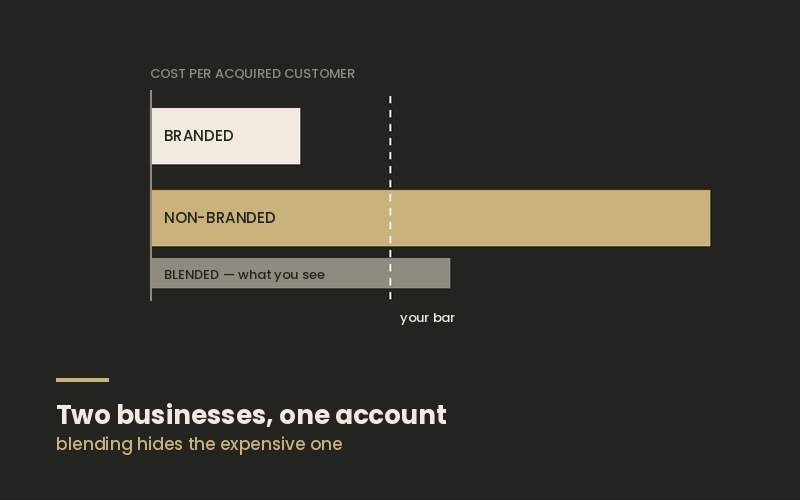
Your Google Ads Account Has Two Businesses In It
Branded and non-branded search are different businesses with different economics, and blending them hides the expensive one.
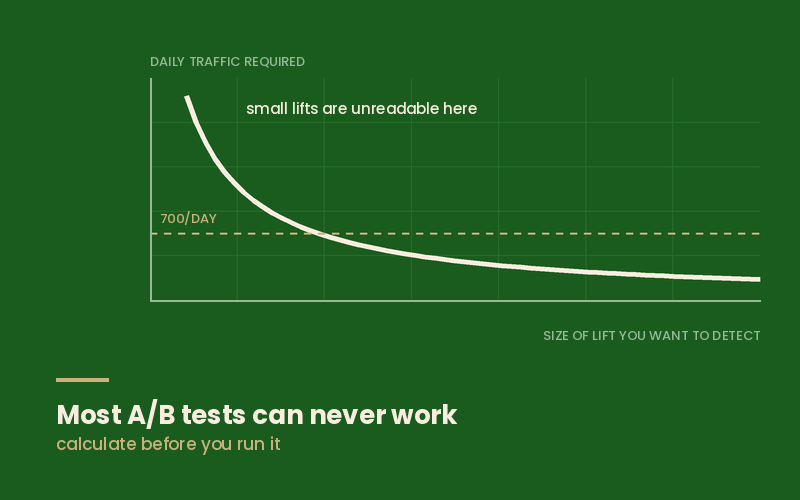
Why Most Website A/B Tests Can Never Work
You can calculate before you start whether a test has enough traffic to produce an answer. Most don't, and they end in "we're not sure."
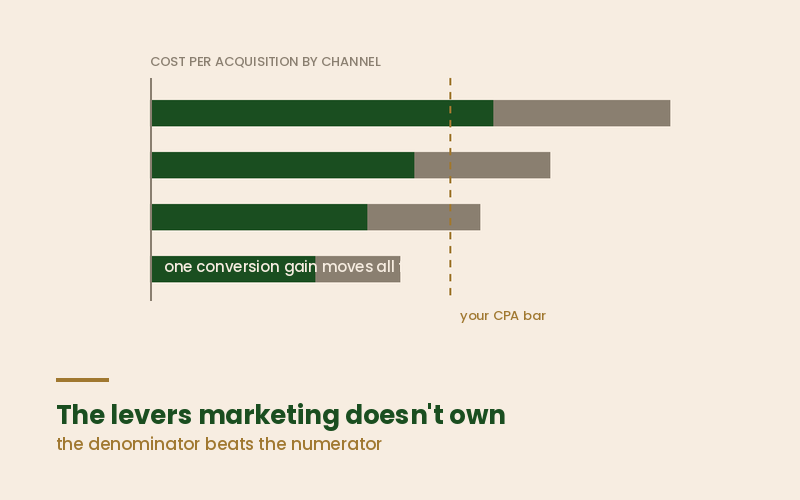
The Conversion Levers Marketing Doesn't Own
The variables with the largest effect on conversion are usually owned by finance or operations, and no one has priced the marketing consequence.
Get in touch
with us
Contact Us