
Your Cheapest Channel Might Be Your Worst
Every marketer knows to compare channels on cost per acquisition. Far fewer compare them on what those customers are worth afterward — and the gap between those two habits is where a specific, expensive mistake lives.
The trap
Two channels. The first acquires customers at $200; the second at $500. On cost alone, the first wins decisively and any reasonable person shifts budget toward it.
Now look at what happens next. The $200 customers churn at 8% a month — average lifetime of about twelve months. The $500 customers churn at 3% — about thirty-three months.
At $100 a month in gross margin, the cheap customers are worth $1,200 and cost $200. Ratio: 6. The expensive ones are worth $3,300 and cost $500. Ratio: 6.6.
The expensive channel is better. And that is before considering that the cheap channel's customers occupy your support team for the same twelve months while generating a third of the revenue.
Why this hides so well
Blended numbers conceal it completely. Add the two channels together and you get an average acquisition cost, an average churn rate, and a ratio somewhere in between — a set of numbers that describes no actual customer and points at no decision.
It also hides because the two facts arrive at different times. Acquisition cost is visible today, in the ad platform. Retention is visible in a year, in the billing system. Nobody is looking at both at once, and the person managing spend is being judged on the number that arrives first.
And the incentives point the wrong way. Channel performance is usually reviewed monthly on CPA. The person who shifts budget toward the cheap channel is rewarded immediately and has moved on before the churn shows up.
What to do about it
Tag acquisition source on the customer record, not just the lead. This is the whole game and it is a one-time engineering task. If source lives only in your ad platform or only on the lead object, you will never be able to answer the question. It has to survive onto the customer.
Group customers by acquisition month and track each cohort separately. Cohort analysis is how you see whether the customers you are acquiring now are better or worse than the ones you acquired last year. A blended average cannot show you that, because it is dominated by whichever cohort is largest.
Watch for degradation as spend scales. If cohorts get worse as budget grows, you are running past the audience the channel actually serves — buying attention from people less inclined to buy. That is saturation, and it means the channel has a ceiling well below the one you were planning against.
Compute lifetime value per channel, and rank on that. It is the same calculation you already run for the business, segmented by source. Once you have it, the ranking often changes materially — and the channel you were about to cut for being expensive turns out to be the one worth defending.
The rule
Cost per acquisition is half a number. It only means something paired with what the acquired customer is worth, and those two figures can point in opposite directions.
Anyone can find you cheap customers. The question is whether they stay.
A channel with low acquisition cost and poor retention looks like your best performer in blended numbers. It is often your worst.
Related Blogs
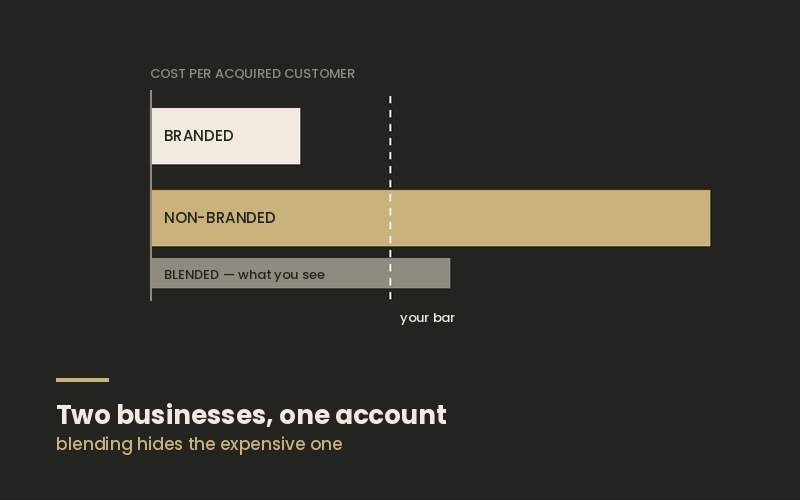
Your Google Ads Account Has Two Businesses In It
Branded and non-branded search are different businesses with different economics, and blending them hides the expensive one.

Why Most Website A/B Tests Can Never Work
You can calculate before you start whether a test has enough traffic to produce an answer. Most don't, and they end in "we're not sure."
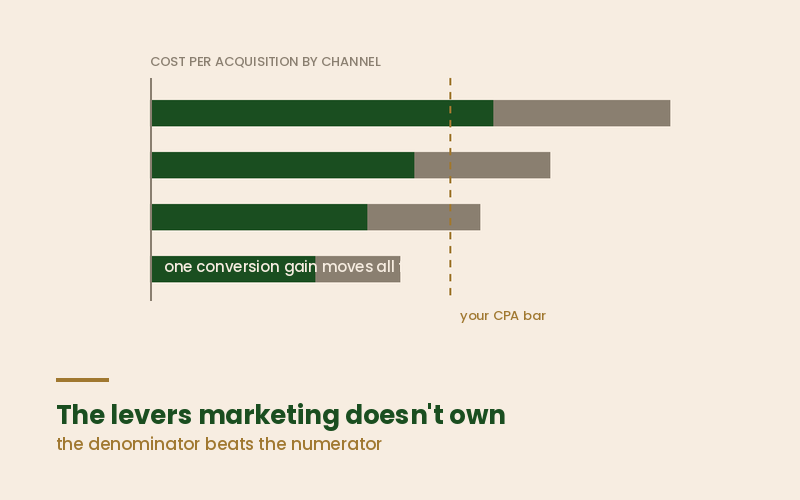
The Conversion Levers Marketing Doesn't Own
The variables with the largest effect on conversion are usually owned by finance or operations, and no one has priced the marketing consequence.
Get in touch
with us
Contact Us